Keep a more uniform malt candidate
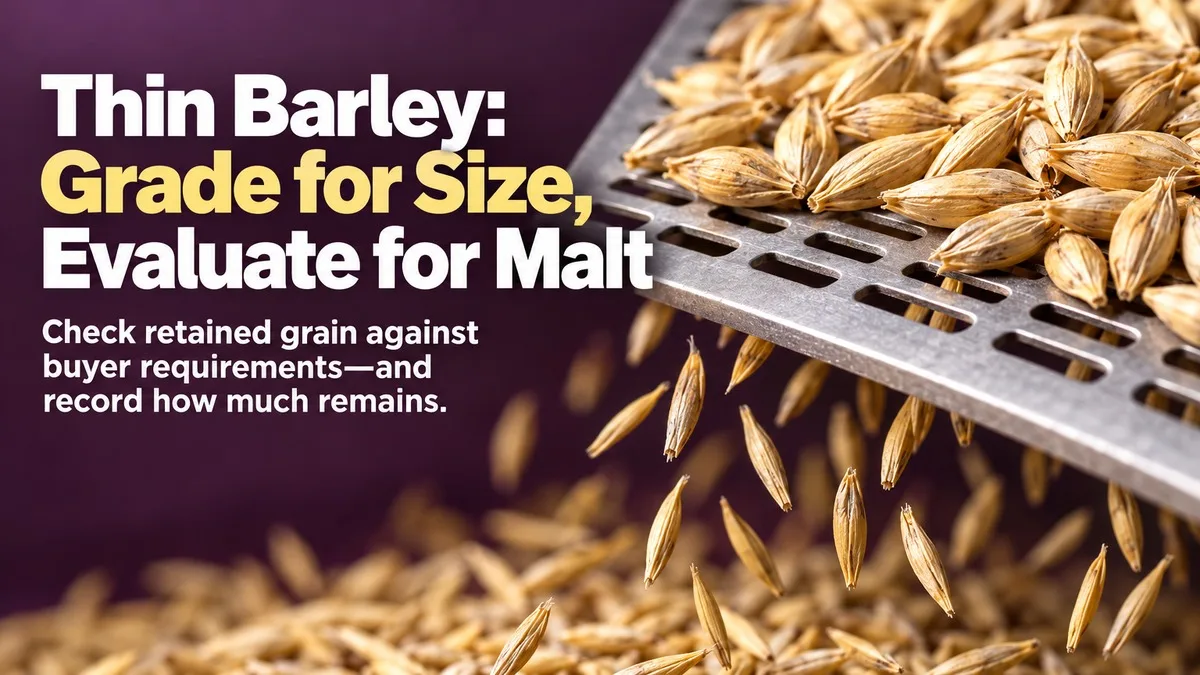
When a barley lot contains thin kernels, size grading can separate them out and leave a more uniform fraction for malt evaluation. Judge that retained grain—the portion you keep—by two things: how it measures up to your intended buyer’s current requirements and how much of the original lot remains.
Why kernel size matters in malting
Uniform size has a practical purpose. Different barley size fractions take up water and germinate at different rates during malting. University of Minnesota Extension explains that those fractions are malted separately and the thinnest kernels are not malted.
Metra VDSC vibration grain cleaners separate grain by size. That makes screening relevant to removing thin kernels while keeping a more uniform barley fraction. The useful result is a better-defined malt candidate, not simply a larger pile of screenings.
Let the buyer define the target
Ask the intended malt buyer for current specifications and sample-submission instructions before choosing a grading target. Confirm which screen and percentage the buyer uses to assess kernel size, then have the retained fraction evaluated using those requirements.
Size is only one part of that evaluation. Ask for the buyer’s requirements for:
– Germination, protein and moisture.
– Accepted variety and varietal purity.
– Kernel uniformity and peeled, broken or damaged kernels.
– Foreign material, insects, ergot and deoxynivalenol, or DON, also called vomitoxin.
Penn State’s 2024 Pennsylvania guidance identifies these as malting-barley quality factors. Its malting-barley overview also explains that acceptance values can vary by buyer. Use your buyer’s current limits rather than treating a general guideline as the purchase specification.
A favorable size result does not establish germination or DON compliance; those need their own results. Compare the retained barley’s full report with the buyer’s requirements to see whether size grading addressed the obstacle to malt acceptance or another quality issue remains.
Keep size percentage separate from retained weight
Record the incoming weight and retained weight for the same grading run, alongside the retained grain’s quality results. These answer different questions:
– Size compliance: What percentage of the retained sample meets the buyer’s size requirement?
– Retained yield by weight: What percentage of the incoming lot remains in the retained fraction?
Hypothetical example: Start with 1,000 pounds and retain 850 pounds. Retained yield is 850 ÷ 1,000 × 100 = 85% by weight. That does not mean 85% of the retained grain meets the size requirement, or that you recovered 85% of all suitable malting kernels.
If you also want to measure recovery of kernels meeting a size criterion, you need total output weights and representative size-composition results on the same basis. Equal-sized handfuls from the retained grain and screenings cannot establish recovery.
Together, the buyer’s quality results and the retained weight show both what you achieved and how much barley remains as a malt candidate.
Get help with the size-grading job
For help separating thin kernels from your barley, contact Metra at info@graincleaner.com. You do not need to choose a model first. Metra can discuss a grain sample test and help select equipment and settings around your material and cleaning needs.