Follow the deduction in two places
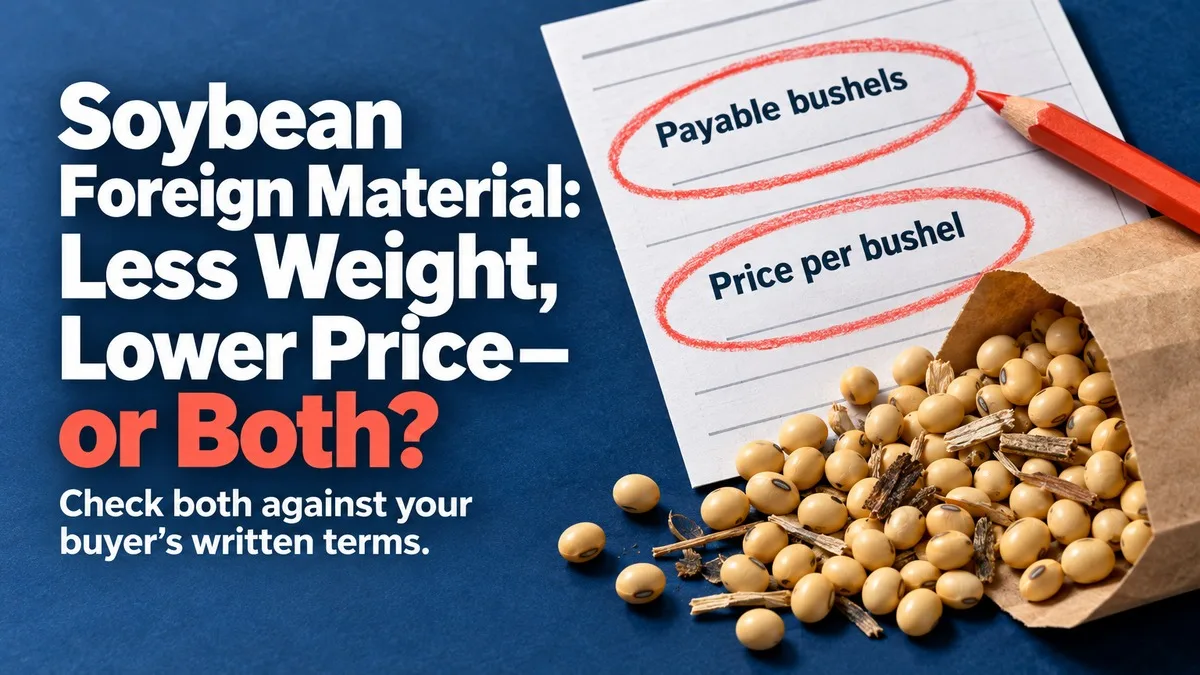
If foreign material shows up on your soybean settlement, check both payable quantity and price per bushel. A weight deduction reduces the quantity purchased; a price discount reduces the dollars paid per bushel. Your buyer’s written terms determine whether one or both apply. Then identify what counted as foreign material so cleaning targets the material behind the deduction.
Start with the terms that apply to your delivery
Put the settlement ticket beside the contract and the buyer’s effective discount schedule. USDA AMS defines contract price and discounts separately: the contract includes the agreed price and sale conditions, while a discount is a scheduled deduction from the cash price.
Find these details in your terms, and ask the buyer to explain anything the ticket leaves unclear:
– The foreign-material percentage assigned to the load and the applicable allowance.
– Whether a weight deduction applies to all foreign material or only the amount above the allowance.
– Whether a price discount applies, and how it is calculated.
– The calculation order and rounding used to reach payable quantity and final price.
Have the buyer trace the foreign-material adjustment separately from other settlement adjustments. An unchanged price per bushel does not mean foreign material had no effect: the buyer may have reduced payable quantity instead.
Keep quantity and price separate until the multiplication
USDA’s 1996 soybean-cleaning report describes both weight deductions and price discounts. Use that distinction – not the report’s historical allowances—to read today’s ticket.
Follow whichever situation your written terms specify:
– Weight deduction only: trace the reduction from the applicable starting weight to payable quantity. Do not also subtract a price discount for foreign material.
– Price discount only: trace the reduction in dollars per bushel. Do not also reduce quantity for foreign material.
– Both: calculate each adjustment in the buyer’s stated order, then multiply the resulting payable bushels by the resulting price per bushel.
The basic calculation is:
Payable bushels × settled dollars per bushel = grain payment before separately listed charges.
Illustrative arithmetic only: assume the completed ticket shows 1,000 payable bushels at $10.00 per bushel. The multiplication is 1,000 bushels × $10.00/bushel = $10,000. Those assumed figures are not a buyer’s quote or deduction schedule. The important step is establishing how the buyer reached each figure before multiplying them.
Ask what actually counted as foreign material
Ask the buyer to show or describe the material classified as foreign material in the inspected sample. Was it dirt, plant parts, weed seeds, other grain or small soybean pieces?
The 1996 USDA report describes soybean foreign material as material passing a specified inspection sieve plus nonsoybean material remaining after sieving. That explains why the category is not limited to obvious stalks and trash – and why appearance alone does not tell you how a particle was counted.
Connect the deduction to that classification before choosing a cleaning method. Everything a cleaner removes is not necessarily material that caused the foreign-material deduction.
Match cleaning to the material behind the deduction
For dirt and debris that differ in size from the soybeans, Metra VDSC screening separates by size. This addresses size-different unwanted material while retaining the useful soybean fraction.
For lighter unwanted material that responds differently to air than the soybeans, ADS and ADS-CDC use controlled airflow to direct material into separate fractions. Airflow response depends on mass, shape, dimensions and density—not weight alone.
The material decides the method. Size-different debris points toward screening; lighter, air-responsive material points toward airflow cleaning. A foreign-material percentage by itself does not select the machine.
To compare the settlement effect after cleaning, use the retained quantity and the retained soybeans’ foreign-material assessment under the same buyer terms. Recalculate both payable quantity and price. A lower foreign-material percentage alone does not establish a larger payment.
Contact Metra at info@graincleaner.com to discuss a sample test focused on the material behind your soybean deduction. You do not need to choose a machine first. Metra can demonstrate separation with your sample and help select suitable equipment and settings.