Keep useful white wheat
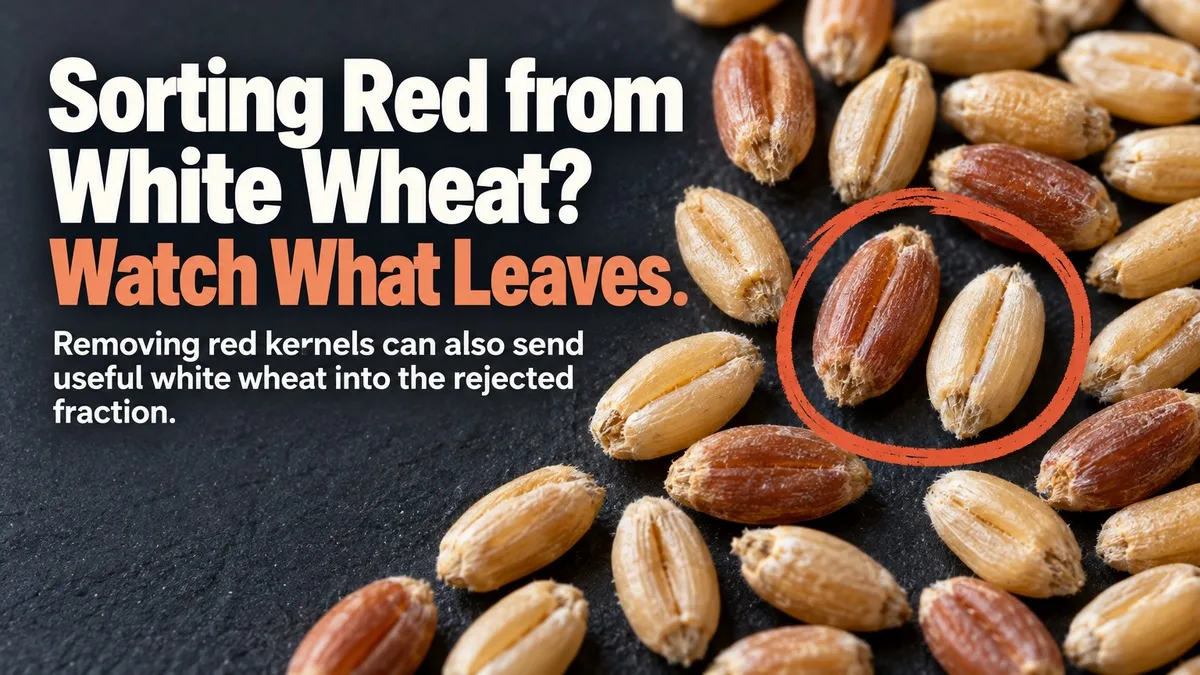
Red wheat mixed into white wheat can affect the quality assessment and market value of your harvest. Metra 6AS optical color sorters help separate unwanted red kernels from white wheat using precise color recognition, allowing you to retain valuable white wheat and improve the composition of the cleaned lot.
The goal is straightforward: remove red kernels, preserve useful white wheat and prepare a cleaner product that better meets your buyer's requirements. A free Metra sample test lets you see the separation results using your own grain.
Use the actual color contrast
Metra 6AS optical sorters select material by color, and Metra can configure and pre-program selection for the customer's requirements. For this job, the target is color-different red kernels, with white wheat directed to the retained output.
The important condition is whether the colors in your mixture provide a useful selection target. Color selection is not a wheat-class assessment. It addresses the visible difference; the retained wheat still needs to be assessed for its intended class.
Soft White and Hard White do not count red wheat the same way
Confirm the buyer's intended white-wheat class, grade and class-mixture limits before judging the result. USDA's term “contrasting classes” is a grading category—not simply a description of kernels that look different.
Under the USDA wheat standards, dated May 2014, U.S. No. 2 Soft White and Hard White wheat have maximum limits of 2.0% contrasting classes and 5.0% total wheat of other classes. Contrasting classes are included in that total, not allowed on top of it.
Hard Red Winter wheat illustrates why the receiving class matters:
– In Soft White, Hard Red Winter counts toward both the contrasting-class limit and the total-other-classes limit.
– In Hard White, Hard Red Winter counts toward total wheat of other classes, but not contrasting classes.
For a hypothetical retained sample with 3.0% Hard Red Winter and no other off-class wheat, that mixture exceeds the U.S. No. 2 contrasting-class limit for Soft White. In Hard White, it is within these two class-factor limits. That does not establish the full grade or buyer acceptance; compare the assessment with the buyer's actual terms.
Do not extend the Hard Red Winter example to every red wheat. Soft Red Winter is contrasting in both Soft White and Hard White.
Judge class composition and white wheat retained together
Request a class assessment of the retained wheat, including contrasting classes and total wheat of other classes. USDA determines these factors after removing dockage and shrunken and broken kernels from the inspection sample. That is the grading basis, not a required production-cleaning sequence.
Then distinguish two results:
– Purity is the desired wheat class's share of the retained output.
– Recovery is the share of the original desired wheat that reaches the retained output.
A cleaner-looking output can still send useful white wheat into the removed fraction. The 6AS manual recognizes that desired material can accompany rejected material.
To quantify recovery, record the total incoming and output weights for the same run and obtain representative class composition for the incoming wheat and each output. Use a consistent weight basis. Equal-sized handfuls can show a visible difference, but they cannot establish how much of the original white wheat was retained. Keep this recovery accounting separate from the USDA-prepared grading sample.
See how your wheat separates
Metra offers free grain sample testing to demonstrate how optical color sorting separates red kernels from white wheat.
During the demonstration, you can:
– See how 6AS identifies and removes color-different red kernels.
– Compare your original wheat with the cleaned white wheat.
– Examine the separated fractions and evaluate how much useful wheat is retained.
– Get recommendations for the equipment and sorting settings suited to your grain.
You don't need to select a machine or configuration before contacting Metra. Our team will help evaluate your sample and recommend a suitable solution.
Send your wheat sample and see the difference for yourself.
Contact info@graincleaner.com or call +1 701 515-0488 to arrange your free sample test. Your manager will coordinate the sample quantity, shipping and demonstration arrangements.