Start with grain coming in and going out
Can you add a grain cleaner to your existing auger, elevator or conveyor system without rebuilding the entire grain-handling setup? In many cases, the answer depends on three things: whether your equipment can feed the cleaner consistently, whether the connections line up, and where the cleaned grain and removed material will go. You don't need to design an entire cleaning line before exploring your options. Start by documenting your current grain route. A simple sketch, a few measurements and photos can help determine what equipment can stay and what may need to change.
What to record at the farm
Make a simple sketch showing how grain currently moves through your farm equipment. Mark the proposed cleaner location, the incoming grain route and the destinations for cleaned grain and removed material.
Include these details:
– Existing equipment: Makes and models of the augers, elevators or conveyors you want to keep.
– Capacity: Available throughput ratings, including units and crop type. Distinguish manufacturer ratings from actual measured performance.
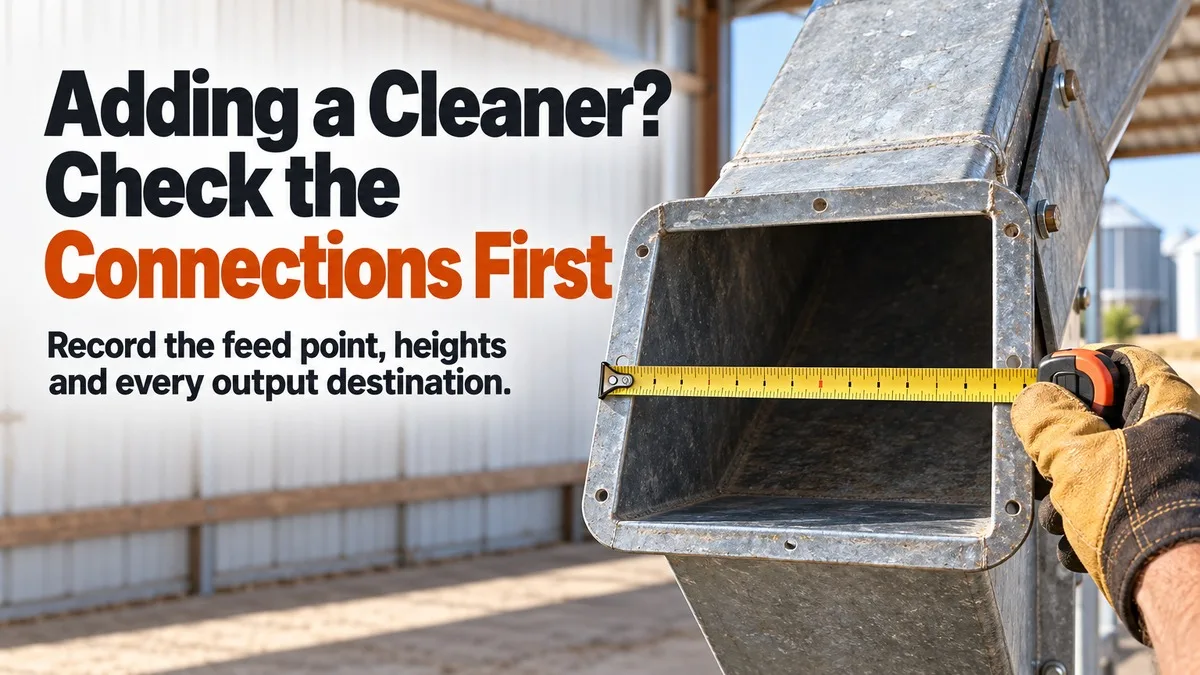
– Connection heights: The discharge height of the incoming equipment and the receiving height of downstream equipment.
– Distances: Horizontal and vertical distances between connection points, using the same ground or floor reference.
Photos and dimensions: Wide photos of the grain-handling setup, close views of accessible connections and opening dimensions where they can be obtained safely. Penn State Extension's Grain Auger Safety guide explains that augers may operate horizontally, at an angle or vertically, depending on the application and grain volume. Documenting the arrangement is therefore as important as recording the model. Keep all guards in place when inspecting your setup. Penn State advises shutting equipment down and following lockout/tagout procedures before servicing.
What the supplier should confirm
Ask the supplier to resolve these details for the proposed cleaner and configuration:
– Feed requirements: Can the existing equipment deliver grain at the required rate, and how will delivery be controlled? The Metra ADS 600-2000 manual describes uniform delivery matched to the machine's cleaning capacity.
– Physical connections: Confirm inlet and outlet sizes, shapes, positions and elevations, along with any required vertical drop. Identify transitions – connecting pieces between openings – and their support requirements.
– Every output route: Show where cleaned grain and each removed-material stream will go, and what will receive or convey it.
– Equipment supplied: Confirm whether feeding equipment and connecting pieces are included or supplied separately. For example, the MGC manual identifies its mobile elevator as optional.
Two manual details show why a connection needs more than a matching opening. The VDSC manual calls for inlet-tube positioning that sends material toward the center and spreads it evenly across the separator surface. The ADS 600-2000 manual describes separate discharge paths for light impurities and screened large and small impurities. These are model-specific examples: ask the supplier to mark the actual inlet alignment and output routes for your proposed machine.
Get the unresolved connections onto one drawing
Even when existing equipment appears compatible, a few practical issues can affect installation.
1. The existing auger cannot reach the cleaner's inlet. The auger's discharge point may be too low or positioned too far from the cleaner's intake. Depending on the layout, the installation may require a different equipment position, additional conveying equipment or a suitable transition.
2. There is nowhere for the removed material to go. A grain cleaner may produce more than one output stream. Your existing system might have a suitable destination for cleaned grain but no receiving container or conveyor for separated impurities. For example, the Metra ADS 600-2000 manual describes separate discharge paths for light impurities and screened large and small impurities. Each output needs a planned destination.
3. The feeding equipment and cleaner have different capacities. An existing auger or conveyor may not deliver grain at the rate required by the selected cleaner. Inconsistent feeding can also affect cleaning performance.
The Metra ADS 600-2000 manual specifies uniform grain delivery matched to the machine's cleaning capacity. The supplier should confirm how the proposed equipment combination will maintain the required feed rate. These examples show why connecting a cleaner involves more than matching the dimensions of two openings.
Once you have documented your setup, the next step is to match it to a specific cleaner and configuration.
The supplier should verify:
– Feeding: Whether the existing equipment can supply grain at the required rate and how the flow will be controlled.
– Inlet and outlet connections: Opening sizes, positions, elevations and any required transitions or vertical drop.
– Material destinations: Where cleaned grain and each separated fraction will be collected or conveyed.
– Additional equipment: Whether elevators, connecting pieces and supports are included or need to be supplied separately.
These details vary by machine. For example, the Metra VDSC manual specifies inlet-tube positioning that directs grain toward the center and distributes it evenly across the separator surface. Correct alignment matters for consistent feeding. The ADS 600-2000 manual also identifies a mobile elevator as optional equipment, demonstrating why included and separately supplied components should be confirmed before installation.
Put the complete grain route on one drawing.
Before ordering connecting pieces or arranging fabrication, request a marked installation drawing showing how the cleaner will fit into your existing setup. The drawing should identify which equipment can remain, any additional components required, the planned inlet and outlet connections, and who will supply each part. Follow the grain route from the incoming discharge point, through the cleaner and toward every receiving point. This makes it easier to identify missing connections, unsupported transitions or output streams without a destination. The result should be a practical installation plan based on your actual farm equipment rather than assumptions about compatibility.
Find out what can stay in your grain-handling system.
You may not need to replace your existing augers, elevators or conveyors to add a grain cleaner.
Discuss a grain sample test
Metra can help evaluate your current equipment, cleaning requirements and site layout to identify a suitable cleaner configuration and determine which connections need adjustment.
Send your equipment details, a simple sketch and photos of your grain-handling setup to info@graincleaner.com.
The Metra team can review your requirements and help determine which parts of your existing grain route can remain and what needs to be confirmed before installation.