Build a field shortlist, not just a yield ranking
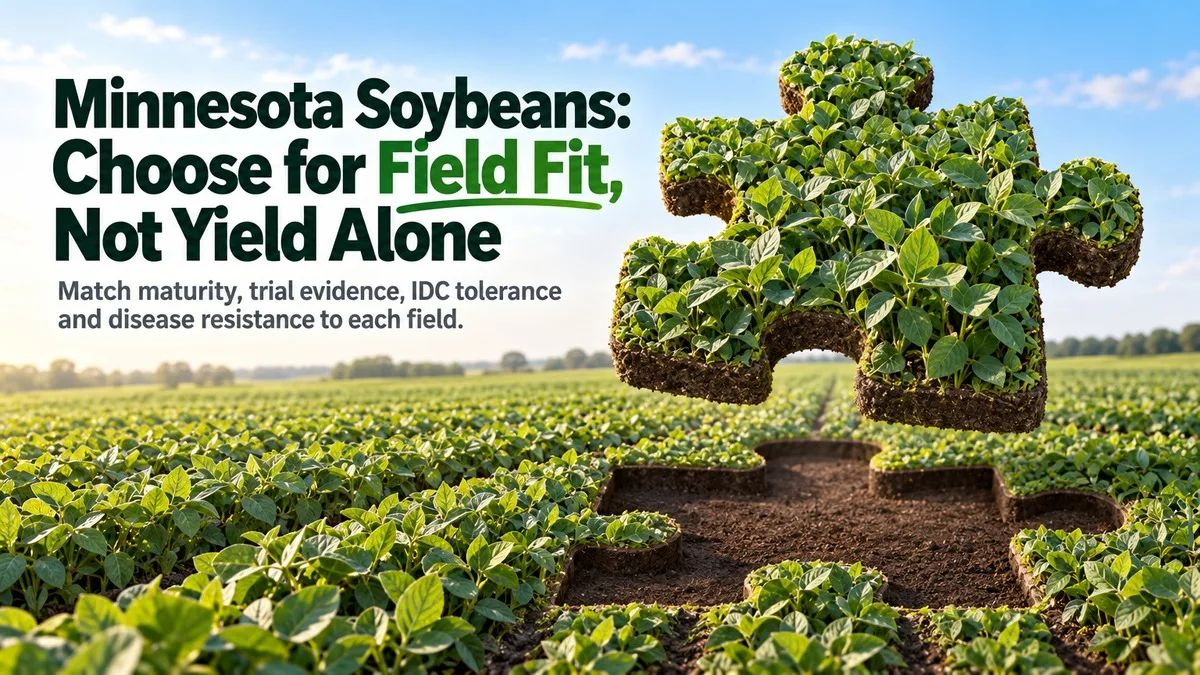
Choosing soybeans for your Minnesota fields starts with maturity fit, then yield evidence and the problems documented in each field. Compare similar-maturity entries within the same trial, check supporting results across locations and years, and match iron deficiency chlorosis tolerance and disease resistance to field history. The highest yield number alone doesn’t settle the choice.
Set maturity limits before comparing yields
Start with varieties adapted to your location and a maturity that fits your harvest schedule. University of Minnesota Extension recommends the longest-season varieties that fit the operation’s logistics. Spreading maturities can spread exposure to extreme weather, but it can also put soybean harvest in conflict with corn harvest.
Once you’ve set that range, compare entries of similar maturity. North Dakota State University’s December 2025 soybean selection guide explains the tradeoff: later maturity can increase yield potential, but an early fall frost can interrupt seed filling. A later entry’s yield lead isn’t a reason by itself to stretch your maturity window.
Read the trial notes before calling a winner
UMN’s soybean hub points growers to Minnesota Agricultural Experiment Station trials of appropriately adapted public and private entries. The program evaluates yield as well as iron deficiency chlorosis, protein, oil and resistance to certain diseases.
For each candidate, record the exact variety name, trial location and year. Compare yield numbers within the same table and read that report’s statistical notes.
In NDSU’s replicated trials, the least significant difference, or LSD, is the yield gap used to judge whether two entries differ statistically. A difference smaller than the table’s LSD is treated as similar performance. NS means no significant difference was detected among entries for that trait. Use each table’s own notes and LSD, not a value borrowed from another trial.
Then look for repeat performance across relevant sites and years. NDSU recommends averages across several locations and years because next season’s weather is unknown. UMN also recommends checking Minnesota Variety trials, FIRST results and local strip trials for independent support. One location-year winner is less useful than a candidate with supporting performance under several conditions.
Let field history determine which weaknesses matter
Pull together your existing scouting notes, laboratory diagnoses, soil information and yield maps. Note where problems occurred, not just whether the farm has seen them. UMN recommends mapping trouble areas and recording their associations with growing conditions and management. During future scouting, send plant problems you can’t identify in the field to a diagnostic lab.
Use that record to identify the resistance information you need for each candidate. A broad description such as “good disease package” doesn’t answer whether the variety fits the documented problem in this field.
For soybean cyst nematode, or SCN, UMN advises checking greenhouse and local-field evidence for resistance to the SCN population in your field. Commercial varieties differ in resistance level, so the SCN-resistant label alone isn’t enough. Resistance is available for only some diseases; variety choice is one part of managing those field problems.
Give IDC its own column
Iron deficiency chlorosis, or IDC, is yellowing caused by inadequate usable iron in the plant. Soil may contain plenty of iron but not enough in a form the plant can use. Higher soil pH, especially with abundant calcium carbonate, reduces iron solubility. Keep IDC tolerance separate from disease-resistance ratings.
For a field with an IDC history, UMN recommends choosing the most tolerant variety possible as the first line of defense. Among candidates with similar IDC tolerance, keep comparing yield potential and other needed traits.
Read the rating scale before ranking candidates. For example, NDSU’s Sept. 2, 2026 release describes North Dakota replicated IDC trials rated at three growth stages on a scale of 1 to 5: 1 meant no chlorosis, and 5 meant the most severe chlorosis. That is a symptom score, not a yield score. Use the scale supplied with the report you’re reading.
If two adapted candidates have statistically similar yields but one has better documented IDC tolerance, that tolerance is a strong reason to favor it for a field with an IDC history. A small numerical yield lead shouldn’t outweigh a known weakness for that field.
Compare three candidates for one field
Copy this blank aid for one intended field. Three columns keep the shortlist manageable; they aren’t a recommendation for how many varieties to plant across the farm.
Field name: ______
Documented problems and affected areas: ______
Maturity and harvest limits: ______
Candidate A
Exact variety name and maturity:
Trial location, year and report:
Yield in bu/acre and within-table comparison:
Table’s LSD or statistical notes:
Supporting results at other sites or years:
IDC rating, scale and source:
Resistance evidence for this field’s diseases or SCN:
Missing information to resolve:
Keep or drop for this field, and why:
Candidate B
Exact variety name and maturity:
Trial location, year and report:
Yield in bu/acre and within-table comparison:
Table’s LSD or statistical notes:
Supporting results at other sites or years:
IDC rating, scale and source:
Resistance evidence for this field’s diseases or SCN:
Missing information to resolve:
Keep or drop for this field, and why:
Candidate C
Exact variety name and maturity:
Trial location, year and report:
Yield in bu/acre and within-table comparison:
Table’s LSD or statistical notes:
Supporting results at other sites or years:
IDC rating, scale and source:
Resistance evidence for this field’s diseases or SCN:
Missing information to resolve:
Keep or drop for this field, and why:
Mark missing information “unknown” rather than treating it as a strength. Use those blanks to focus your next discussion with your seed supplier or crop adviser. Keep the candidates that combine maturity fit, supported yield performance and the traits this field needs.