Start with the spread pattern
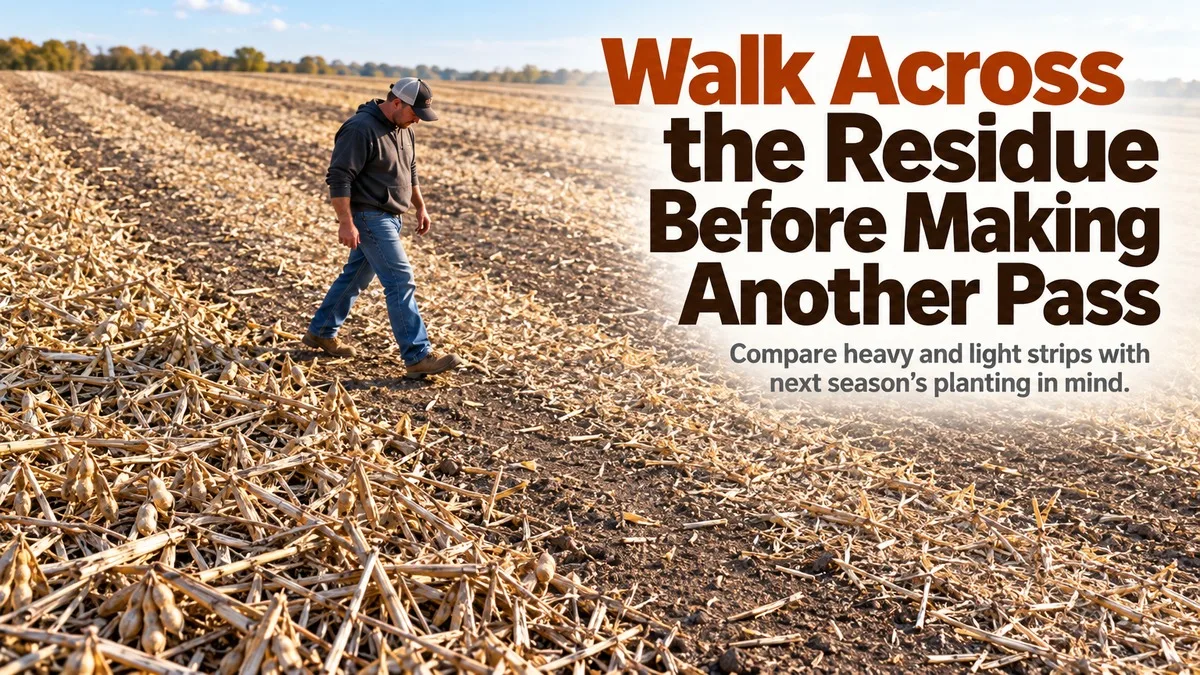
Heavy residue strips beside lightly covered ground after corn or soybean harvest call for a distribution check, not an automatic tillage pass. Walk across adjacent harvested widths, compare stalk material and fine chaff, and check whether the spread reaches the full header width. Then judge the pattern against the soil conditions and planter performance your next crop needs.
Look across the pass, not just down the row
Compare the center and edges of each harvested width and the boundary between neighboring passes. Look for repeated heavy bands alternating with thin coverage. Abundant residue spread evenly is a different situation from residue concentrated in narrow strips.
Check larger stalk pieces and fine chaff separately. Chaff is the small, light plant material discharged during harvest. As Penn State Extension points out, chaff often leaves the combine at a different location than stalk material. A wide stalk spread can therefore hide a narrow chaff band.
The target is even coverage across the full header width. Note which material falls short and whether residue is piled toward one side. South Dakota State Extension identifies wind as a contributor to where discharged residue lands, so an uneven band alone doesn't prove a spreader defect.
If harvest continues, check the spreading equipment
Use the field pattern to guide the next combine inspection:
– Check that the chopper and spreading mechanism function properly.
– Inspect chopper knife sharpness. South Dakota State Extension notes that sharp knives help produce even-sized residue pieces.
– Check spreader vane and paddle settings and look for worn parts, as Iowa State Extension recommends.
– Include the chaff spreader in the check rather than judging only the larger stalk pieces.
After an adjustment, walk the newly harvested ground once the combine is clear. Compare coverage across the full width again under similar crop and wind conditions. The useful result is fewer heavy bands and more even coverage, not simply smaller pieces.
Iowa State's 2026 harvest guidance gives a clear priority: when wind or dry residue makes a fine cut and even spreading difficult to achieve together, favor even distribution across the full header width.
On finished acres, make the decision about planting
Before choosing corrective field work, consider how the heavy and light strips could affect your planned planting system, especially no-till. Penn State Extension explains that heavy residue bands can stay cooler and wetter while lightly covered strips become warmer and drier, creating uneven germination and early growth.
For soybean residue specifically, Iowa State identifies possible effects on planter ride, seed depth, seed-to-soil contact and emergence. These are the concerns to carry into a field-management discussion – not whether the field looks tidy.
Compare the heavy and light strips as planting approaches. Are soil drying and planting conditions different where residue is concentrated? Consider those differences alongside the planter or drill you intend to use. Don't assume planned tillage will erase the pattern; Iowa State's residue guidance shows that tillage is not a complete fix for poor distribution.
Choose any corrective work to address the planting problem you've identified. If harvest is still underway elsewhere, improving the spread now keeps the same pattern from being repeated on more acres.