Start with where the water came from
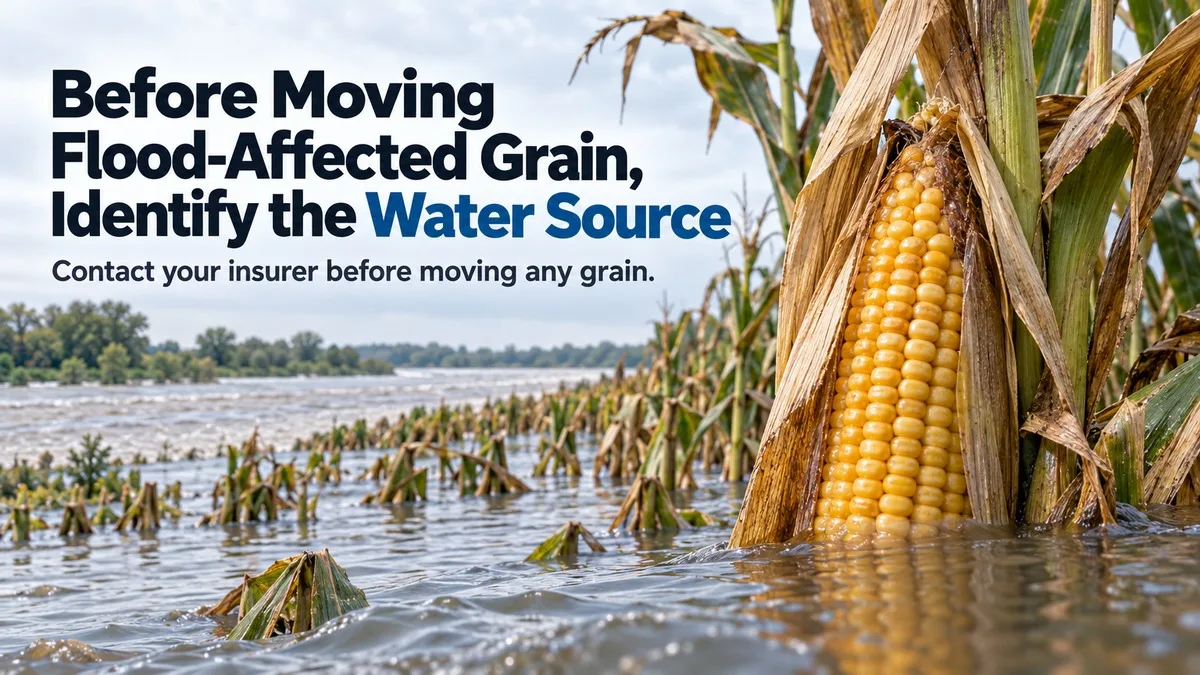
If water affected your grain, first establish where it came from and whether it reached the grain. Rain-wet grain and grain submerged by river water require different decisions. That distinction helps you identify what needs separate evaluation and whom to call. After flooding, contact your insurance carrier before moving any grain.
Separate wet harvest conditions from floodwater contact
Iowa State University Extension’s October 5, 2026 harvest guidance discusses two different Iowa concerns: corn harvested at higher-than-normal moisture and crops flooded by rivers, streams or irrigation canals. Wet harvest conditions alone do not establish floodwater exposure.
Use the exposure history to distinguish these situations:
- Direct rainfall without floodwater contact: This is a moisture and grain-quality issue, not the same exposure as river-submerged grain.
- Grain submerged by river, stream or irrigation-canal water: Iowa State says this grain is adulterated – legally excluded from human and animal food commerce and required to be destroyed. Never blend flood-damaged grain with good grain.
- Rainwater pooled in low ground: Iowa State’s June 2024 flood guidance identifies possible salvage options, but pooling does not automatically establish that the water was uncontaminated. Evaluation and potential reconditioning for sale require written consent from the Food and Drug Administration, or FDA.
Grain that remained above floodwater on partially submerged plants needs a different decision. Iowa State calls for a case-by-case risk evaluation to determine contaminant testing, rather than automatic clearance or destruction based on lower-stalk flooding alone.
Don’t assume water rising through tiles or pits during a flood is clean rainwater. Iowa State warns that it may carry sewage, animal waste or chemicals.
Grain above a flooded bin’s waterline needs its own decision
Grain above the flooded portion of a bin is a different category from the submerged grain below it. It may be eligible for salvage, but being above the waterline does not clear it for sale.
Iowa State’s June 28, 2024 guidance says FDA must evaluate that grain case by case before it can be sold for any use. Evaluation and potential reconditioning for further sale require written FDA consent. These salvage provisions apply to grain above the waterline and pooled-water exposure, not to river-submerged grain.
For a flooded bin, do not start aeration fans. Iowa State calls for a qualified electrician to inspect the structure and related electrical components before salvage work, and professional salvage operators for bin-entry precautions.
Make the calls before committing the lot
Use Iowa State’s flood guidance to match each decision with the right contact:
- Before moving grain, consult your insurance carrier. Describe the water source, whether it reached the grain and where the waterline stood.
- Before pursuing a commercial destination for potentially salvageable grain, contact FDA. In Iowa, the Iowa Department of Agriculture and Land Stewardship is the agriculture contact identified by Iowa State. Obtain written FDA consent for evaluation and potential reconditioning for sale.
- Before proposed on-farm feeding of the potentially salvageable good portion, develop a use plan with a veterinarian. This is not permission to feed river-submerged grain.
- For disposal, contact your local Iowa Department of Natural Resources field office for instructions suited to the area.
Keep a written account of the affected area, what you did and why. Iowa State’s documentation guidance specifically includes decisions distinguishing flowing-water inundation from low-ground ponding. A clear exposure record gives your insurer and the responsible agencies the information they need to address movement and use.