Put both choices on the same footing
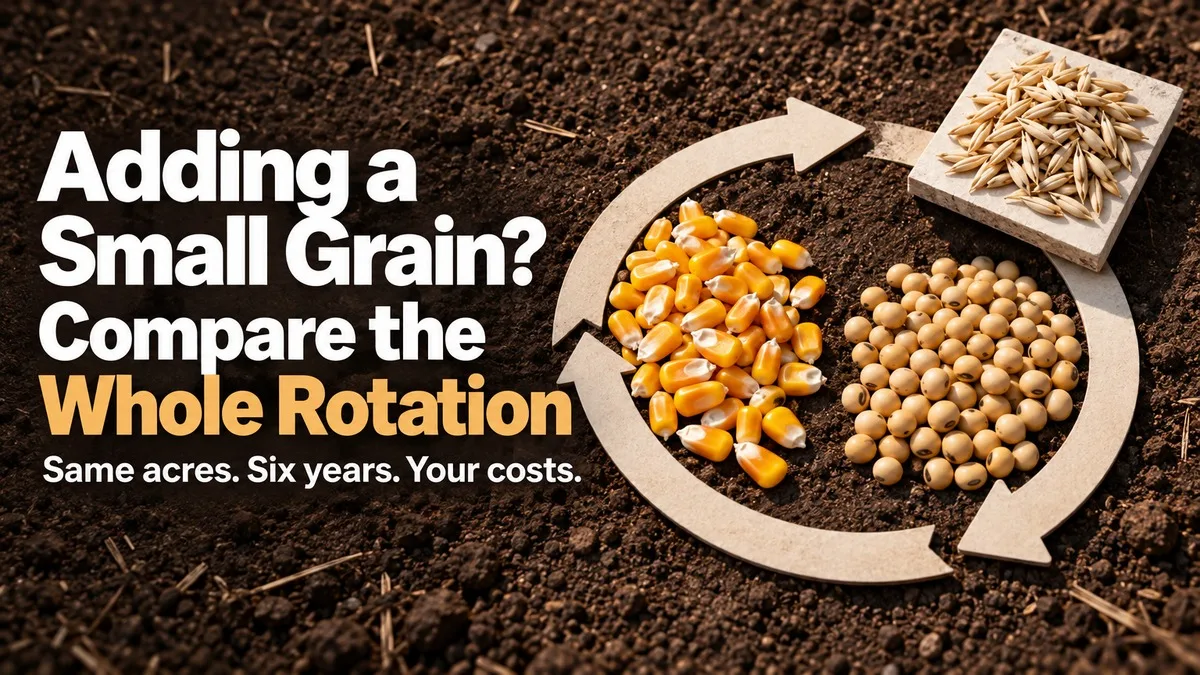
If you’re considering a small grain in your corn-soybean rotation, compare what both rotations leave over six years on the same acres. That covers three corn-soybean cycles or two corn-soybean-small-grain cycles. Use your farm’s costs and a documented outlet for the small grain, then compare both the yearly results and the six-year average.
Start with six crop-year budgets
Use this simple sequence as a comparison worksheet. Replace “small grain” with the crop you’re considering, such as oats.
| Year | Existing rotation | Rotation with a small grain |
| — | — | — |
| 1 | Corn | Corn |
| 2 | Soybeans | Soybeans |
| 3 | Corn | Small grain |
| 4 | Soybeans | Corn |
| 5 | Corn | Soybeans |
| 6 | Soybeans | Small grain |
For each crop-year, enter expected yield, selling price, revenue per acre, costs per acre and the return left after those costs. Calculate grain revenue as expected bushels per acre × expected dollars per bushel. Keep the yield and price units matched for each crop.
Before assigning small-grain revenue, get the prospective buyer’s price or pricing terms, quality requirements, delivery location and delivery period. Budget the applicable costs of reaching that outlet. A price without a workable destination isn’t enough to build the comparison.
Iowa State Extension’s Ag Decision Maker directory lists a Crop Rotation Summary for estimating six-year returns from corn, soybeans and oats or another small grain. It provides a starting point for this comparison.
Use farm costs and count each expense once
Build each budget through the intended sale, not just through harvest. Include seed, fertilizer, chemicals, insurance, machinery operation, labor, land and operating interest, plus applicable drying, storage and hauling costs. Use consistent allocations for shared expenses in both rotations.
Iowa State’s Estimated Costs of Crop Production in Iowa–2026, revised in January 2026, provides Iowa guidelines rather than costs for every farm. Use it to check expense categories, then enter your own estimates. Its production budgets exclude storage and do not include a profit margin or a return to management.
Pay particular attention to three entries:
- Labor. Enter the hours each crop requires and a value for that time, including operator and family labor. Iowa State recommends treating labor as a variable cost when comparing alternative crops.
- Machinery. Include the applicable operating and ownership costs, or custom charges. Don’t count a charge twice by adding expenses already included in it.
- Land. Use the same basis for the same acres in both choices. Iowa State uses a cash-rent equivalent; actual cash outlays on owned land may differ. Don’t add that equivalent on top of rent already counted.
Compare the same kind of return
Keep two results separate: returns over variable costs and returns after all applicable costs. Returns over variable costs are the dollars left after subtracting expenses that vary with production or crop choice. That amount still has to cover any land, machinery ownership or other costs not yet deducted.
Iowa State describes its Crop Rotation Analyzer as comparing annual and average returns over variable costs across six years, with crop inputs and machinery costs separated by enterprise. Don’t label that result full net profit. Add any costs missing from your chosen measure before making the fuller comparison.
For each rotation, add the six yearly returns per acre, then divide by six years.
Hypothetical arithmetic example, not a crop-return forecast: suppose your budgets show six-year totals after all costs you entered of $600 per acre for corn-soybeans and $720 per acre for the rotation with a small grain.
- Corn-soybeans: $600 per acre ÷ 6 years = $100 per acre per year.
- With a small grain: $720 per acre ÷ 6 years = $120 per acre per year.
- Difference: ($720 − $600) per acre ÷ 6 years = $20 per acre per year.
Also compare each year’s result. The average tells you which rotation leaves more over the full period; the yearly figures show where a weak crop-year needs closer attention.
Find the assumption that changes the choice
Start with a comparison that doesn’t automatically credit the small grain with higher yields or lower input costs in later crops. If you expect those changes, put them in a separate scenario and identify the farm records or other evidence behind each estimate.
Then change one uncertain input at a time: the small-grain selling price, its yield or an expected cost saving. Recalculate both the affected year and the six-year average. If the preferred rotation changes, you’ve found an assumption worth checking before committing acres.
Your next step is concrete: gather a small-grain buyer’s terms and fill the six crop-year budgets using the same cost definitions. The useful answer is what the whole rotation leaves on your acres, and which assumptions that result depends on.